
 简体中文
简体中文 Español
 Deutsch
 لالعربية
 Français
 Português
 Русский
Published date: June 11, 2026
Source: HTL CNC
For custom CNC machined aluminum parts, machining accuracy is only one part of the final result. Surface treatment also affects appearance, corrosion resistance, handling performance, assembly quality and the way a part is accepted by overseas customers. Among many finishing options, anodizing surface treatment is one of the most common processes for aluminum CNC parts because it can provide a protective oxide layer while supporting different color finishes such as black, red, blue, gold and natural clear anodizing.
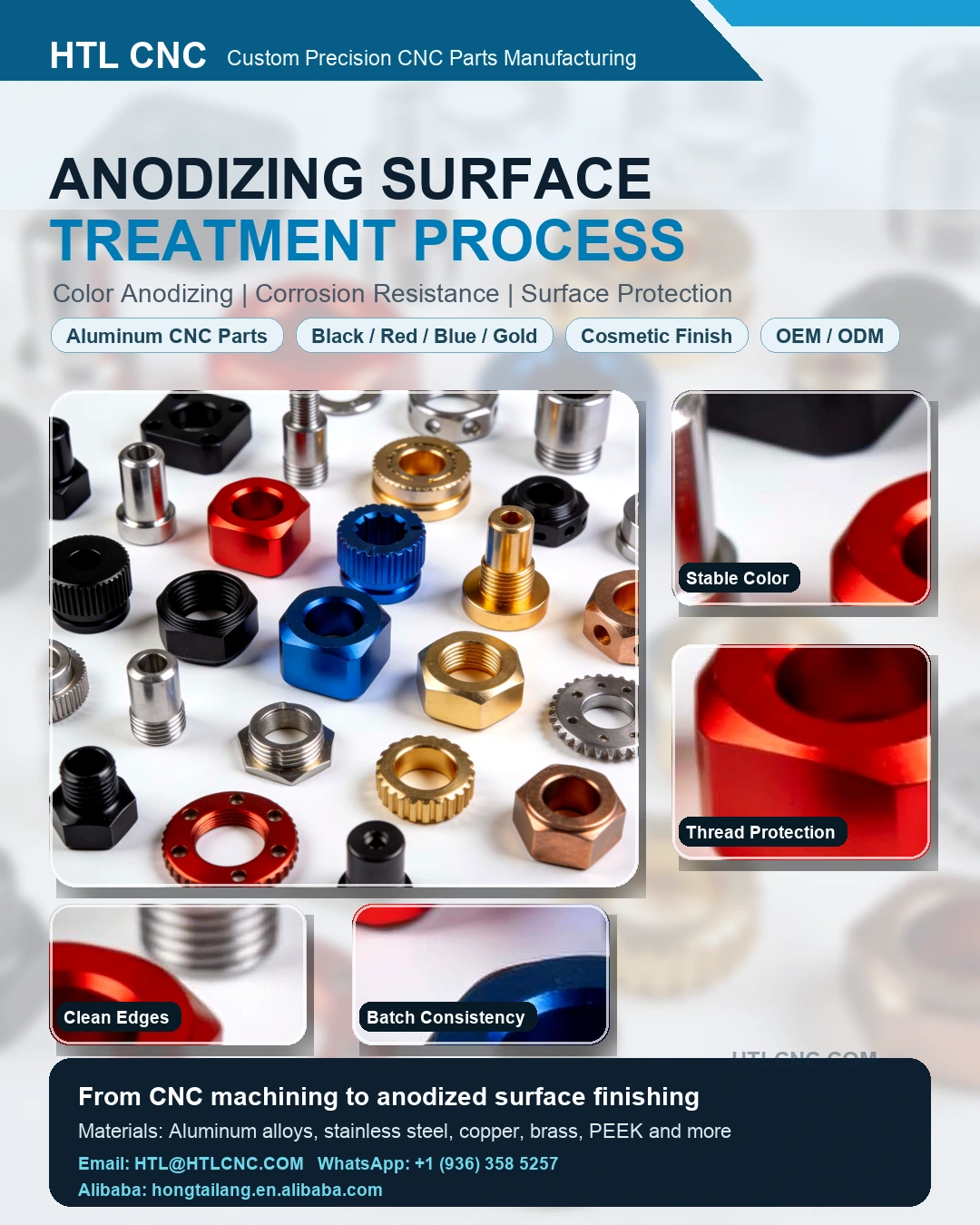
The parts shown in this industry update represent a typical surface finishing topic rather than a single standard product. They include small threaded components, round fittings, knurled parts, hexagonal parts, flange-like pieces and precision machined aluminum parts with different color anodizing results. For buyers searching for anodized aluminum CNC parts, color anodizing or black anodized CNC parts, the key question is not only whether the color looks attractive, but whether the machining, deburring, surface preparation and finishing process work together without affecting assembly.
Anodizing is an electrochemical surface treatment process mainly used for aluminum and aluminum alloy components. During the process, the aluminum surface forms a controlled oxide layer. Depending on the project requirement, the part may then be dyed, sealed or processed with a harder anodized layer. In practical CNC manufacturing, anodizing can help improve corrosion resistance, surface protection and cosmetic consistency. However, every drawing should be reviewed carefully because anodizing thickness, color requirement and sealing method may influence dimensions, threaded holes, tight fits and mating surfaces.
For custom CNC machined aluminum parts, the best anodizing result starts before the surface treatment supplier receives the parts. Machining marks, scratches, burrs, sharp edges and inconsistent polishing can become more visible after anodizing. If a customer requires a cosmetic surface, the machining factory should understand which faces are appearance surfaces, which edges need controlled chamfering and which holes or threads must be protected. This is especially important for visible parts used in drones, robotics, automotive accessories, motorcycle modification parts, automation equipment and consumer-facing industrial hardware.
Color anodizing is often selected when a part needs both surface protection and brand or assembly identification. Black anodizing is widely used for industrial components, UAV parts, optical accessories and mechanical assemblies where a clean technical appearance is required. Red, blue, gold and other colors may be used for motorcycle accessories, custom hardware, automation parts, electronic equipment components and product lines where color coding or visual recognition is useful. For batch production, color consistency should be controlled by material selection, surface preparation, process parameters and inspection standards.
Thread protection is another important point in anodized CNC parts. Small threaded holes, external threads, precision bores and tight assembly interfaces may be affected if coating thickness is not considered. Depending on the drawing, some features may require masking, re-tapping, plug gauges or special inspection after finishing. For overseas OEM buyers, it is useful to mark critical threads, sealing faces and fit areas clearly in the 2D drawing or technical notes so that the CNC machining supplier can prepare a suitable production and post-processing plan.
Different anodizing requirements may lead to different manufacturing choices. A cosmetic anodized aluminum part may focus on color, surface uniformity and clean edges. A functional anodized part may focus more on corrosion resistance, insulation, hardness or wear behavior. Hard anodizing may be considered for components that require stronger surface protection, while decorative anodizing may be enough for many appearance and light-duty parts. The final choice should follow the customer's drawing, product application, material specification and expected working environment.
Quality control for anodized aluminum CNC parts should include both dimensional inspection and surface inspection. Before anodizing, critical machining features such as hole position, thread quality, flatness, bore diameter, chamfer size and mating faces need to be checked. After anodizing, the supplier should review color consistency, surface defects, visible scratches, stains, handling marks, burrs, thread fit and packaging protection. For precision parts, CMM inspection, calipers, thread gauges, plug gauges and visual inspection can be used according to the customer's tolerance requirements.
From a supply chain perspective, many international buyers prefer suppliers that can coordinate CNC machining and surface finishing together. This reduces communication cost and helps avoid problems where the machined part is accurate but the surface finish creates assembly issues. A professional drawing-based CNC manufacturer should evaluate surface treatment early, especially for aluminum alloy parts with tight tolerances, threaded features, cosmetic faces, sealing interfaces or repeat production requirements.
Search terms used by global buyers may include anodizing surface treatment, anodized aluminum CNC parts, color anodizing, black anodized CNC parts, red anodized aluminum parts, blue anodized CNC parts, gold anodized aluminum parts, custom CNC machining, surface finishing for CNC parts, hard anodizing, aluminum prototype machining and OEM precision parts. HTL CNC publishes these industry updates to help engineers, purchasing teams and project managers connect their drawings with suitable CNC machining and finishing solutions.
HTL CNC is a professional precision parts contract manufacturer located in Shenzhen, China. Our factory is equipped with 70 sets of CNC machining and inspection equipment, including five-axis, four-axis and three-axis CNC machining centers, CNC turning and milling compound machines, CNC lathes and three-dimensional inspection equipment. We provide custom CNC machining services for drone components, auto and motorcycle parts, robot components, medical device parts, industrial equipment parts and other non-standard precision components.
For anodized aluminum CNC parts, color anodized components, black anodized precision parts, threaded aluminum fittings, small-batch prototypes or OEM custom metal parts, customers can send 2D drawings, 3D files, samples, material requirements, surface treatment notes and expected quantities to HTL CNC. Our engineering team can review manufacturability, support prototype development and provide quotation support for small-batch and repeat production projects.
Contact HTL CNC for custom CNC machining service:
Company: HTL CNC
Website: www.htlcnc.com
Alibaba: https://hongtailang.en.alibaba.com
Email: htl@htlcnc.com
WhatsApp: +1 (936) 358-5257


