
 简体中文
简体中文 Español
 Deutsch
 لالعربية
 Français
 Português
 Русский
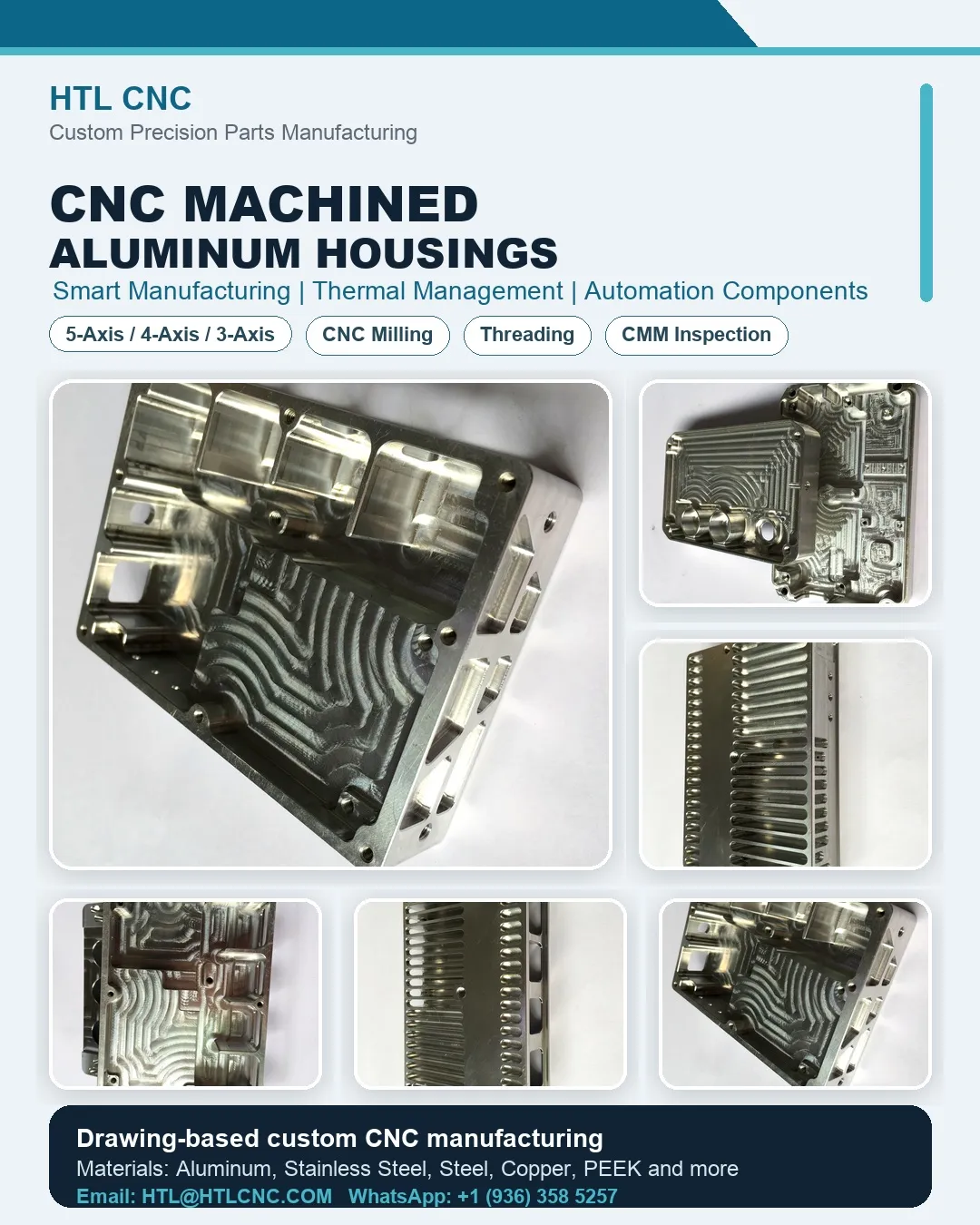
Precision CNC Machined Aluminum Housings Support Smart Manufacturing and Thermal Management
Published: June 3, 2026
Source: HTL CNC
As smart manufacturing, industrial automation, robotics, high-density electronics and AI-related hardware continue to develop, mechanical parts are becoming smaller, lighter and more integrated. Many modern devices no longer use a simple metal shell only for protection. The housing may also provide heat dissipation, precision positioning, structural support, sealing, cable routing, sensor mounting and assembly alignment. This is why precision CNC machined aluminum housings are becoming increasingly important for OEM and ODM projects.
Recent manufacturing and electronics design trends point to stronger demand for intelligent equipment, edge computing, industrial robots, automated production systems, AI control modules, high-speed connectivity hardware and compact power electronics. These applications often require custom aluminum enclosures, CNC milled cavity parts, heat dissipation housings, industrial control housings and precision structural components that can be adapted to a specific design instead of using standard off-the-shelf parts.
Smart Manufacturing Needs More Integrated Metal Components
In smart factories, automation equipment is becoming more modular and data-driven. Machine vision systems, robotic end-effectors, motion control units, sensor modules, inspection devices and industrial communication equipment all require mechanical parts that are stable, compact and easy to assemble. A CNC machined aluminum housing can combine multiple functions into one component, including threaded mounting holes, accurate reference surfaces, internal pockets, connector openings, cable channels and multi-face installation features.
For engineers, this type of custom precision part can reduce the number of separate brackets and covers, simplify assembly, improve layout efficiency and support faster product development. For buyers and supply chain teams, drawing-based CNC machining can also be a practical option for prototype validation, small batch trial production and repeat manufacturing before a part is redesigned for casting, extrusion or another high-volume process.
Thermal Management Is Becoming a Core Design Requirement
With higher power density in electronics, AI hardware, industrial controllers, power modules, sensors and communication devices, thermal management is no longer a secondary detail. Heat can affect signal stability, mechanical reliability, component lifetime and overall equipment performance. Aluminum is widely used for thermal management parts because it offers a useful balance of machinability, strength, weight and heat transfer performance.
CNC machining allows heat dissipation structures to be integrated directly into the part design. Engineers may add ribs, fins, thin-wall structures, internal cavities, contact surfaces, screw bosses and mounting features for thermal pads or electronic assemblies. Compared with a simple enclosure, a precision CNC machined aluminum housing can be designed as a functional thermal management component while still meeting assembly and appearance requirements.
Robotics and Automation Components Require Precision and Consistency
Robotics and automation equipment often depend on precise mechanical interfaces. A housing or structural part may need to hold motors, sensors, bearings, circuit boards, pneumatic components, connectors or optical modules. If hole positions, flatness, thread quality or assembly surfaces are unstable, the final equipment may experience vibration, misalignment or difficult installation.
For robotics aluminum components and automation equipment parts, CNC milling, drilling, threading, chamfering and multi-axis machining can support complex geometry and stable repeatability. Multi-face machining is especially useful when a part includes side holes, angled features, internal cavities or mounting surfaces on different planes. CMM inspection and dimensional checking can further support quality control for parts with tight assembly requirements.
Why CNC Machined Aluminum Housings Matter for OEM Projects
Compared with sheet metal housings, standard extrusion profiles or cast parts, custom CNC machined aluminum housings offer more design flexibility at the early project stage. Engineers can adjust the structure, wall thickness, screw locations, internal cavity layout, connector openings, sealing groove, surface treatment and heat dissipation area according to product testing results. This flexibility is valuable for new equipment development, engineering validation, low-volume manufacturing and customized industrial products.
For customers developing edge AI devices, electronics enclosures, automation modules, sensor housings, industrial control boxes, drone systems, medical device structures or robotic equipment, CNC machining can help reduce the gap between digital design and functional physical samples. When design changes are required, drawings can be updated and the next version can be machined without waiting for expensive mold changes.
HTL CNC Custom Machining Capabilities
HTL CNC provides custom precision CNC machining services for aluminum housings, precision CNC enclosures, cavity components, heat dissipation parts and non-standard structural parts. Based on customer 3D models, 2D drawings, samples or technical requirements, our team can support manufacturability review, material selection, CNC programming, CNC milling, CNC turning, drilling, threading, chamfering, surface finishing coordination and dimensional inspection.
We can process aluminum alloys, stainless steel, steel, copper, brass, magnesium alloys, PEEK and other engineering plastics. For aluminum parts, common surface finishing options may include anodizing, sandblasting, polishing, plating and other treatments according to the customer application. These finishes can help improve corrosion resistance, appearance, wear resistance or insulation-related design needs.
Quality Control From Prototype to Production
For complex housing parts, quality control depends on more than the machining equipment itself. It starts with drawing review, tolerance analysis, process planning, tool selection and clamping strategy. During production, key features such as threaded holes, mounting faces, cavity dimensions, sealing areas, connector positions and surface finish should be checked carefully. For repeat orders, process stability becomes especially important because the same part must fit the same assembly conditions over time.
HTL CNC focuses on practical manufacturing support for overseas customers who need custom CNC machined parts from drawings. Whether the project is a prototype sample, low-volume production or stable batch manufacturing, we welcome customers to send drawings, material requirements, tolerance standards, surface treatment needs and estimated quantity for quotation and manufacturability review.
Typical Application Areas
Precision CNC machined aluminum housings and enclosure parts can be used in smart manufacturing equipment, industrial automation systems, robotics modules, machine vision devices, electronic control units, sensor housings, edge computing hardware, AI-related equipment, drone systems, medical device structures, heat dissipation assemblies, power electronics, communication devices and other custom mechanical projects.
As more industries move toward compact, intelligent and customized equipment, the demand for reliable CNC machined aluminum housings will continue to grow. For many engineers and sourcing teams, working with a drawing-based CNC machining supplier can help shorten development cycles, improve part fit and support flexible manufacturing from early-stage design to production.
Contact HTL CNC
Email: htl@htlcnc.com
WhatsApp: +1 (936) 358-5257
Website: www.htlcnc.com
Alibaba: https://hongtailang.en.alibaba.com


