
 简体中文
简体中文 Español
 Deutsch
 لالعربية
 Français
 Português
 Русский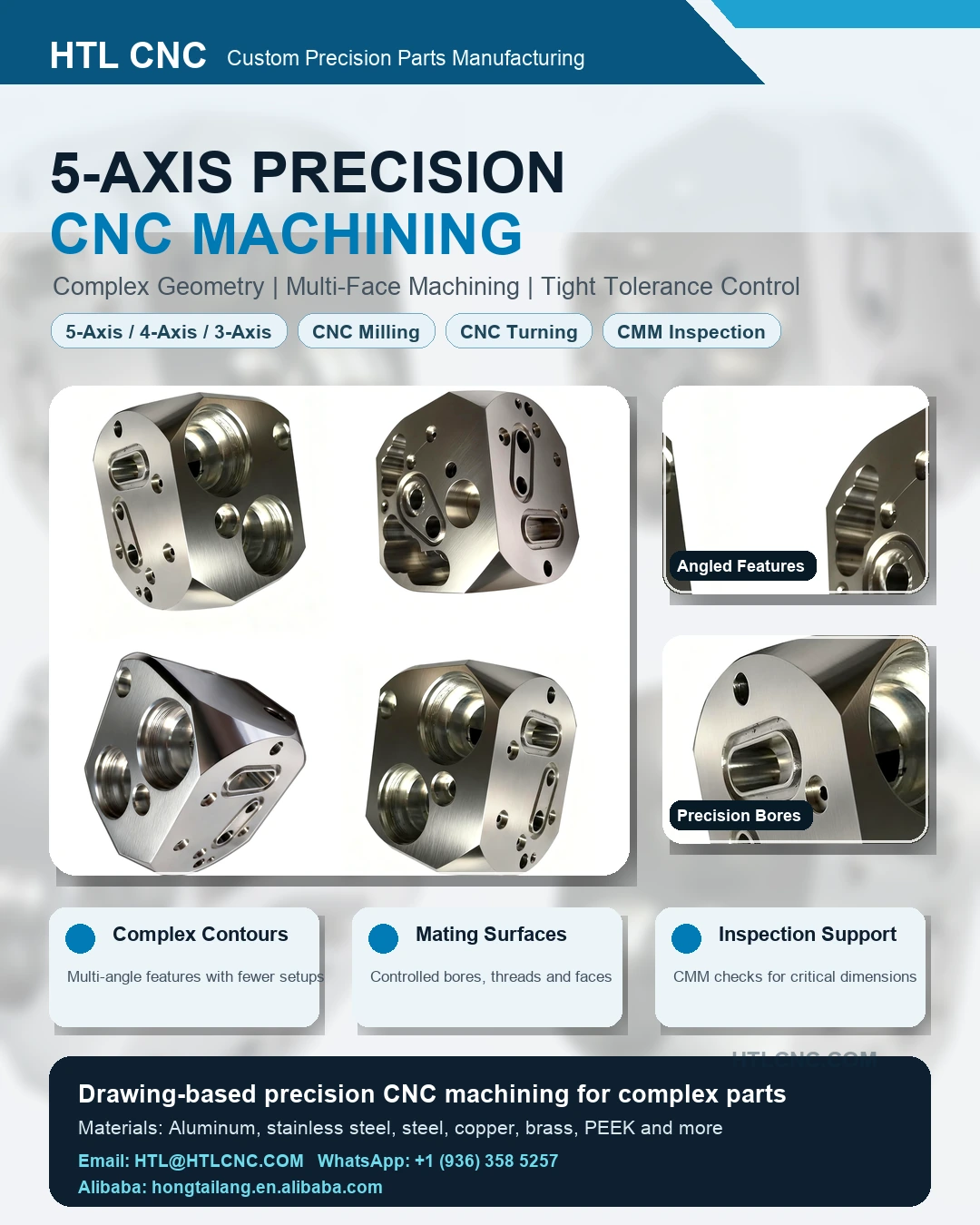
Published date: June 12, 2026
Source: HTL CNC
As industrial products become lighter, more compact and more integrated, many custom metal parts now include multiple functional surfaces in one component. A single precision part may combine angled faces, deep bores, threaded holes, sealing surfaces, side windows, mounting patterns and cosmetic machining marks. For this type of geometry, five-axis precision CNC machining is often an efficient solution because it can reduce repeated clamping, improve access to difficult features and support stable machining of complex custom parts.
The component shown in this industry update is a typical example of a complex CNC machined part with several visible manufacturing challenges. It includes multi-face surfaces, precision bores, slot features, threaded holes, chamfered edges and different machining directions. From an engineering point of view, this type of part is not only about cutting metal into shape. It requires process planning, fixture strategy, tool selection, tolerance control and inspection support so that each functional surface can match the customer's drawing and assembly requirement.
Five-axis CNC machining is useful when a part has features located on different sides or at different angles. Compared with repeated 3-axis setups, a five-axis process can help access more surfaces with fewer clamping operations. This may reduce datum transfer errors, shorten setup time and improve consistency between critical features. For parts with angled pockets, side holes, curved profiles, complex contours or tight mating surfaces, fewer setups can also reduce the risk of misalignment between operations.
In real manufacturing, five-axis machining does not replace every process. A practical machining route may still combine 3-axis milling, 4-axis machining, CNC turning, turn-milling compound machining, drilling, tapping, boring, chamfering and deburring. The correct process depends on the drawing, material, tolerance level, surface finish requirement and order quantity. For some parts, CNC turning may create cylindrical reference features first, while five-axis or multi-axis milling completes angled faces, holes and complex contours afterward.
Precision bores and threaded holes are important inspection points for complex CNC machined parts. Bores may be used for bearings, shafts, alignment pins, sealing interfaces or assembly location. Threaded holes must match fasteners and torque requirements. If a bore position, thread depth, hole spacing or perpendicularity is unstable, the final assembly may face leakage, vibration, alignment or fastening problems. This is why precision machining should be supported by suitable gauges, CMM inspection and clear drawing review.
Mating surfaces are another key topic in five-axis precision CNC machining. Many custom parts need flatness, parallelism, perpendicularity or surface finish control on different faces. A part may look simple from one angle, but the relationship between surfaces can be critical. For example, an angled surface may need to align with a bore centerline, a mounting plane may need to match another bracket, or a sealing face may need controlled roughness. Understanding these relationships helps the machining supplier plan the operation sequence and inspection points correctly.
Material selection also influences the machining strategy. Aluminum alloy is widely used for lightweight precision parts because it offers good machinability and strength-to-weight performance. Stainless steel and steel may be selected when strength, wear resistance or temperature behavior matters. Brass, copper, magnesium alloy, PEEK and other engineering plastics may be used for electrical, thermal, weight or chemical requirements. For each material, tool path, coolant, cutting parameters and surface treatment planning should be adjusted to reduce machining risk.
Surface treatment may be part of the complete manufacturing solution after CNC machining. Depending on the application, parts may require anodizing, hard anodizing, passivation, plating, polishing, sandblasting, black oxide, laser marking or other finishing processes. For precision components, surface treatment must be considered early because coating thickness, masking areas, threaded holes and mating surfaces can affect final assembly. A drawing-based CNC supplier should understand which areas are functional, which areas are cosmetic and which features must remain protected.
International buyers often search for suppliers using terms such as five-axis precision CNC machining, 5-axis CNC machining, complex CNC machined parts, multi-face CNC machining, tight tolerance CNC parts, precision CNC milling, CNC turning and milling, CMM inspection, OEM CNC parts supplier and China CNC machining manufacturer. These search terms reflect the real concerns of engineers and purchasing teams: Can the supplier machine difficult features? Can they hold the dimensions? Can they inspect the part? Can they support prototype and repeat production?
Five-axis machining is especially valuable for industries such as robotics, UAV and drone components, automotive and motorcycle parts, automation equipment, medical device components, optical equipment, industrial fixtures and non-standard mechanical assemblies. These industries often require small-batch prototypes before production, and the design may change several times during validation. CNC machining can support this development path because it allows drawing-based manufacturing without mold tooling at the early stage.
HTL CNC is a professional precision parts contract manufacturer located in Shenzhen, China. Our factory is equipped with 70 sets of CNC machining and inspection equipment, including five-axis, four-axis and three-axis CNC machining centers, CNC turning and milling compound machines, CNC lathes and three-dimensional inspection equipment. We provide custom CNC machining services for drone components, auto and motorcycle parts, robot components, medical device parts, industrial equipment parts and other non-standard precision components.
For five-axis precision CNC machining, complex aluminum parts, stainless steel components, multi-face machined parts, precision bores, threaded holes, prototype samples or OEM custom production, customers can send 2D drawings, 3D files, samples, material requirements, surface treatment notes and expected quantities to HTL CNC. Our engineering team can review manufacturability, support prototype development and provide quotation support for small-batch and repeat production projects.
Contact HTL CNC for custom CNC machining service:
Company: HTL CNC
Website: www.htlcnc.com
Alibaba: https://hongtailang.en.alibaba.com
Email: htl@htlcnc.com
WhatsApp: +1 (936) 358-5257


