
 简体中文
简体中文 Español
 Deutsch
 لالعربية
 Français
 Português
 Русский
Published date: June 16, 2026
Source: HTL CNC
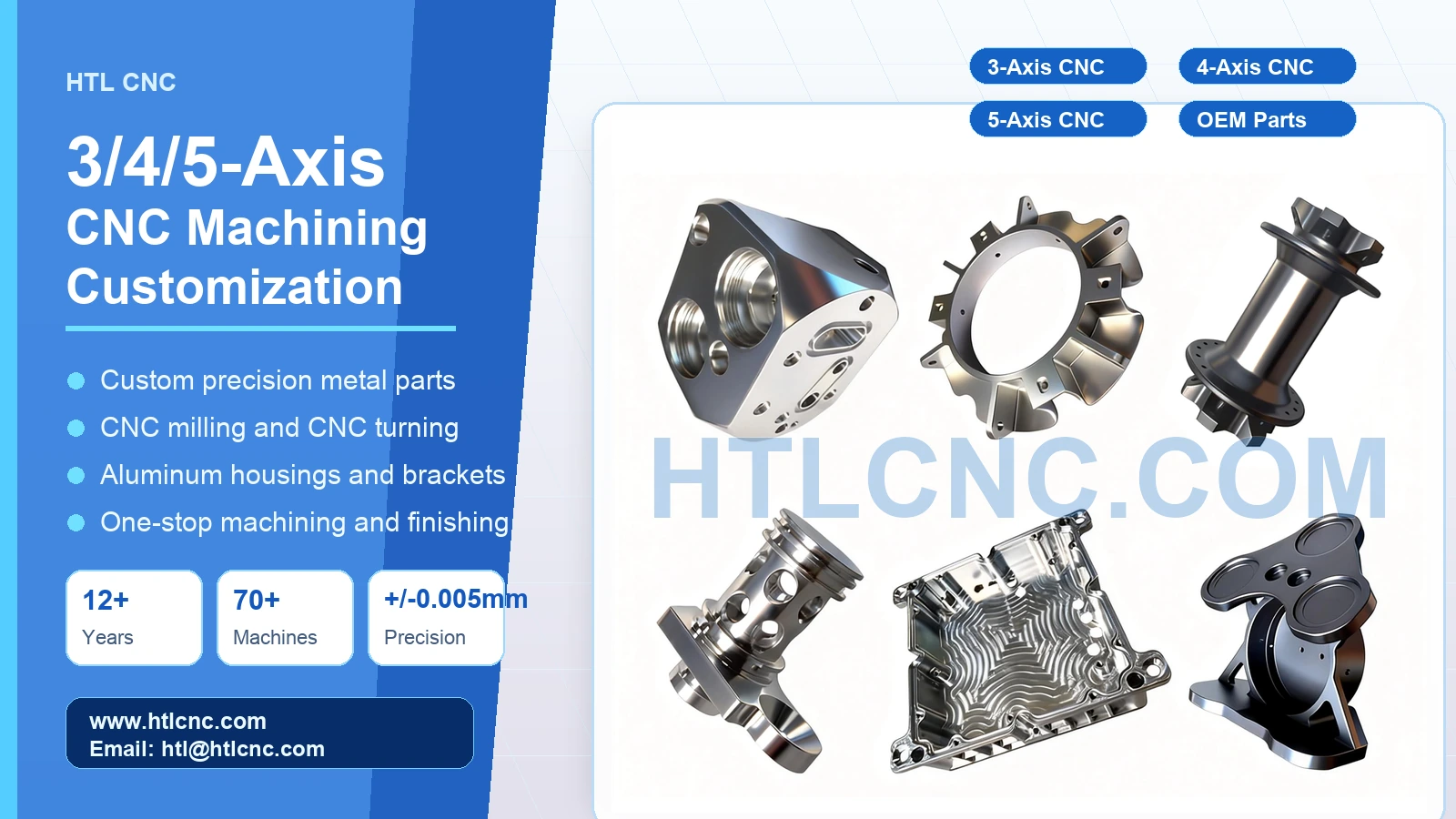
3-axis, 4-axis and 5-axis CNC machining customization is widely used for precision metal parts that require stable dimensions, clean surfaces and reliable assembly performance. For OEM buyers, one machining project may include aluminum housings, mounting brackets, threaded flange parts, cavity plates, robot structural components, drone parts, optical instrument parts and automation equipment parts. Choosing the right CNC machining process helps control cost, accuracy and delivery time from prototype samples to repeat production.
In custom CNC machining, 3-axis machining is often used for flat surfaces, drilling, tapping, pockets, slots and general milled parts. It is efficient for many aluminum parts and precision hardware components when the geometry can be reached from a limited number of setups. For parts with multiple side features, accurate hole positions and repeated clamping requirements, 4-axis CNC machining can improve machining efficiency and consistency by rotating the workpiece during processing.
5-axis CNC machining is especially valuable for complex structures, curved surfaces, deep cavities, angled holes and parts with tight assembly relationships. When a component needs high precision across several planes, reducing manual repositioning can help improve geometric accuracy and surface quality. This is why 5-axis CNC machining is often selected for drone components, aerospace parts, robot parts, optical instrument parts, medical equipment parts and high-end automation equipment components.
The parts shown in this update reflect common requirements in custom precision machining: threaded holes, curved surfaces, thin-wall areas, bearing seats, mounting faces, lightweight structures and decorative or functional surface finishes. These features require careful toolpath planning, material control, deburring and inspection. Small errors in flatness, hole position, thread quality or surface finish can affect assembly, sealing, motion performance and final product reliability.
HTL CNC supports one-stop precision parts manufacturing with CNC milling, CNC turning, turn-mill machining, 3-axis machining, 4-axis machining and 5-axis machining. Our factory is equipped with CNC machining centers, CNC lathes, turn-mill machines, 2D/3D measuring instruments, microscopes and height gauges. With full-process quality control including IQC, IPQC and OQC, we can provide dimensional inspection support for custom CNC parts.
Material and finishing choices are also important for CNC machined components. Aluminum parts may require anodizing, sandblasting, polishing, plating, painting, laser marking or silk screen printing according to corrosion resistance, appearance, identification and assembly needs. HTL CNC can combine CNC machining with surface treatment and assembly services, helping customers reduce supplier coordination and keep project quality more consistent.
For customers looking for custom CNC machining, 5-axis CNC machining, aluminum parts machining, CNC turning, precision metal parts machining, drone parts machining, robot parts machining, automation equipment parts machining or optical instrument parts machining, HTL CNC can review drawings, discuss manufacturability and provide machining suggestions based on structure, tolerance, material and finishing requirements.
If you need 3-axis, 4-axis or 5-axis CNC machining customization for precision metal components, please send your drawings, samples or project requirements to HTL CNC. Our team will help evaluate the process route and provide practical support for prototype and batch production.


