
 简体中文
简体中文 Español
 Deutsch
 لالعربية
 Français
 Português
 Русский
Published date: June 6, 2026
Source: HTL CNC
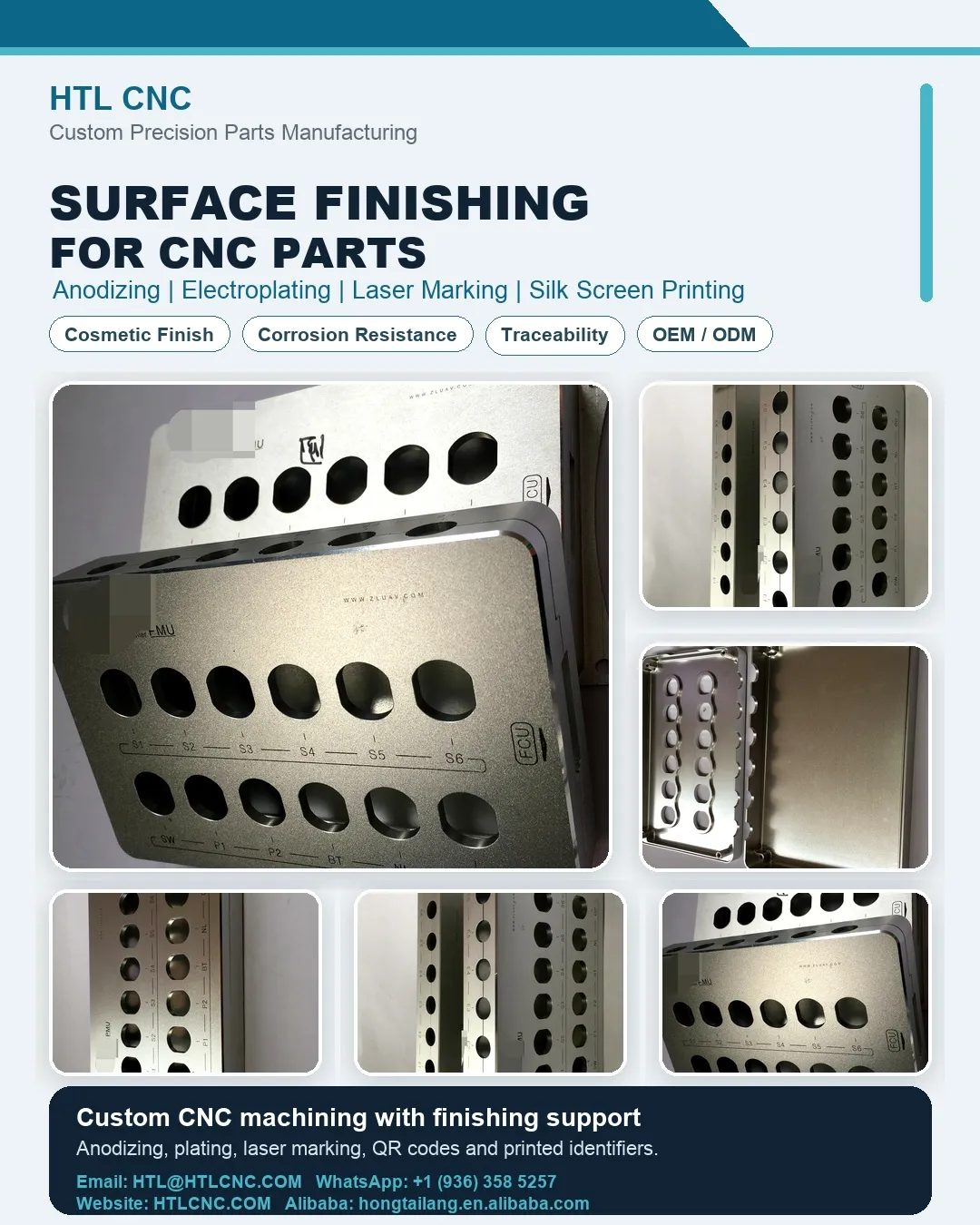
In custom precision parts manufacturing, CNC machining is often only the first stage of turning a drawing into a finished component. For many overseas buyers, the final application also depends on surface finishing, part identification and stable cosmetic quality. An aluminum housing, control panel, bracket, cover plate or structural component may need anodizing for corrosion resistance, electroplating for functional protection, laser marking for traceability, or silk screen printing for clear visual instructions. These finishing requirements can influence how engineers design the part, how manufacturers hold tolerances and how the final component performs in real assembly conditions.
As industries such as robotics, UAV systems, automotive electronics, motorcycle accessories, medical devices, automation equipment and industrial instruments continue to use more customized metal parts, the demand for reliable CNC surface finishing is becoming more practical and more specific. Buyers are no longer looking only for a machined shape. They often need a complete manufacturing approach that considers material selection, machined surface quality, post-processing allowance, marking readability, packaging protection and repeatable appearance from sample to batch production.
Anodizing for aluminum CNC parts
Anodizing is one of the most common finishing options for aluminum CNC machined parts. It can improve corrosion resistance, create a more consistent surface appearance and support different color requirements when specified by the customer. For parts used in electronics, robotics, drone assemblies, machine frames, control housings and consumer-facing equipment, anodized aluminum can provide both functional and visual value. Black anodizing, clear anodizing and colored anodizing are frequently requested in custom aluminum machining projects.
However, anodizing should be considered during the design and machining stage, not only after machining is completed. Tight-fit areas, threaded holes, sealing surfaces and mating dimensions may be affected by the finishing layer. If a part needs masking, special surface roughness, matte appearance, sandblasting before anodizing or hard anodizing for higher wear resistance, these requirements should be clearly marked on the 2D drawing or RFQ document. A good CNC machining supplier should review these details early so the customer can reduce rework risk before production.
Electroplating and functional surface protection
Electroplating is another important post-processing method for custom machined parts. Depending on the material and application, customers may request zinc plating, nickel plating, chrome plating, tin plating or other coating solutions. Electroplating can support corrosion resistance, wear resistance, electrical contact performance or a specific visual finish. It is often used for steel parts, stainless steel parts, brass parts, copper parts and selected functional components.
For CNC machined parts that require electroplating, communication is especially important. Engineers should define which surfaces are cosmetic, which surfaces are functional, which holes or threads must remain clean, and whether there are assembly areas that require masking. The final plating thickness, surface brightness, color tone and salt spray requirement should also be confirmed according to the customer's standard or application environment. HTL CNC can support drawing-based machining and coordinate finishing requirements according to customer specifications, helping buyers manage the connection between machining and post-processing.
Laser marking, engraving and part traceability
Laser marking and engraving are widely used for CNC parts that need product names, model numbers, serial numbers, assembly direction marks, scale lines, logos, QR codes or Data Matrix codes. In many industrial supply chains, traceability is becoming more important because buyers need to identify part batches, maintenance information or assembly positions quickly. Laser marking can provide a clean and durable identification method on many metal surfaces when the material and finish are suitable.
For overseas buyers, part marking is not only a branding detail. It can help reduce assembly mistakes, support spare part management and make inspection more efficient. For example, a machined aluminum panel may need printed labels for buttons or ports, while a structural component may need engraved part numbers for batch tracking. When marking is required, the customer should provide the logo file, text content, marking position, size, depth or readability requirement. These details help prevent misunderstandings and make the final part easier to inspect.
Silk screen printing for panels, plates and housings
Silk screen printing is still valuable for many CNC machined panels, front plates, enclosure parts and control housings. It can be used for text, icons, warning marks, interface labels and customer branding. Compared with engraving, silk screen printing is often selected when the design requires clear color contrast, larger graphic areas or a smoother visual presentation. It is common in industrial instruments, communication equipment, electronic housings, automation devices and operator-facing mechanical parts.
To achieve stable silk screen printing quality, the surface condition before printing must be controlled. The part should be clean, the finish should match the ink requirement, and the drawing should define the printed artwork clearly. For repeat orders, keeping the same surface treatment, color standard and printing artwork is important because small differences may be visible on assembled products. This is why CNC machining, surface finishing and printing should be planned together rather than handled as isolated steps.
Why post-processing should be included in DFM review
Design for manufacturability review is especially useful when a custom CNC part includes surface finishing. Sharp edges may need chamfering before anodizing or plating. Deep pockets may affect coating uniformity. Blind holes, threaded holes and precision bores may need protection. Cosmetic surfaces should be identified so the machining team can reduce unnecessary tool marks, scratches or clamping damage. If the part requires laser marking or silk screen printing, the flatness and available marking space should also be checked.
A practical RFQ package should include the 3D model, 2D drawing, material grade, tolerance notes, surface treatment requirement, color requirement, marking artwork, expected quantity and inspection focus. This allows the manufacturer to evaluate machining time, finishing feasibility, packaging protection and quality control more accurately. For prototype development, the customer can also use early samples to confirm whether the finishing appearance and marking position match the final product design.
HTL CNC provides custom precision CNC machining services for aluminum alloys, magnesium alloys, steels, stainless steel, copper, brass, PEEK and other engineering plastics. Our capability covers 5-axis, 4-axis and 3-axis CNC machining, CNC turning, turning and milling compound machining, CNC lathe processing and inspection support. For projects that require anodizing, electroplating, laser marking, engraving or silk screen printing, we can review the drawing requirements and help customers coordinate suitable finishing support according to the part material and application needs.
From a search and procurement perspective, buyers may describe similar requirements using different terms, including CNC surface finishing, anodized aluminum parts, plated machined parts, laser marked CNC parts, engraved aluminum panels, silk screen printed housings, custom front plates, precision machined control panels, OEM aluminum enclosures and drawing-based CNC manufacturing. HTL CNC continues to publish industry news and technical articles around these real manufacturing topics so international buyers can find the right CNC machining support when preparing RFQs, prototype orders or production projects.
If you are developing custom CNC machined parts that require anodizing, plating, laser marking, engraving, silk screen printing or other surface finishing support, you are welcome to send us your drawings, material requirements, finishing notes and expected quantity. Our team will review the information and provide practical support for prototype development, small-batch production and OEM/ODM precision parts manufacturing.
Contact HTL CNC
Email: htl@htlcnc.com
WhatsApp: +1 (936) 358-5257
Website: https://www.htlcnc.com/
Alibaba: https://hongtailang.en.alibaba.com/


